Thursday, June 29, 2017

2017 Storm Chase Day 3 - 6/28/17 - Three tornadoes!

Jackpot.

Iowa is a crappy place to chase severe storms. On the plains, the roads are usually a north-south, east-west grid, and that makes it easier to get to where you need to be to view the storm--and possibly its tornado--in contrast to places like Iowa, where rolling hills, while pretty, necessitate that the roads wind and twist, and are thus difficult to navigate.

However, we knew that Caryn (our co-guide), Heidi (my wife), and I, were good-luck charms for Iowa. As far as Heidi and I, when we were out chasing with Roger (the other co-guide) and Caryn the previous time we were in Iowa, we saw twelve tornadoes (eight at night!).

Thus, good-luck charms aside, although we knew there was a significant threat for an outbreak, we also knew getting into position to see any of them would be difficult (if there was one at all). So while we witnessed three tornadoes yesterday (Wednesday, 6/28/17), if it wasn't for a clearing through a well-placed open gate, we wouldn't have gotten a good picture of any of them. As luck would have it, I got into position take this picture:


The tornado is the sliver of a tube on the right side of the cloud lowering (wall cloud). Note the clearing I was in. We were stuck on the road, unable to see anything, because of the hills and trees, when we noticed a field across the road through an open gate. We took advantage of it and saw this little guy. It was the second tornado that we encountered, and it was extremely short-lived.

Here's another picture showing its funnel cloud before touching down. It actually looks more impressive here, but, strictly speaking, it wasn't a tornado at that point.


We thought the entire lowering would drop and form a wedge (trapezoid shape) tornado, but it never did. Instead, we got this little guy. We'll take him.

The first tornado we saw lasted so short a time that I couldn't get a picture of it. Since it was largely invisible (a tornado isn't required to be visible), it wouldn't have made a good picture anyway.

The third tornado we encountered was the type of tornado I hoped I would see for my entire life--a white elephant-trunk. *Unfortunately* all I got was a fleeting glimpse of it as we drove by at the tail end of its existence, and I could barely make it out. So I don't consider that quest completed. From the pictures I've seen on the Internet (go looking for them, I don't have permission to use them), I know if we were in a better position (and had been there earlier), we would have seen what I've been looking for.

Well, there's always next time! I'll take a day with *any* tornadoes. This was my 31st day chasing with Roger, and while I've seen twenty tornadoes, I only saw them on five of those days. So while, on average, I see a tornado 65% of opportunities, I still only saw tornadoes only on 16% of days, or a one-in-six chance. Doing the math, this translates to a 65% chance of seeing a tornado on a six-day tour. Indeed, I am four-for-six.

And I've been very fortunate in that I haven't had a chance to sight-see due to no storms. HOWEVER, earlier in the afternoon, we did get a picture of a covered bridge in Madison county:


I won't compare this to the covered bridges in New England.

Here is the GPS track of this chase.


Today (Thursday, 6/29/17), there is also a significant tornado threat. We should be in the Nebraska, Kansas, Iowa and Missouri border area. Crossing my fingers! Tomorrow (6/30/17) has an enhanced threat for severe storms in the Ozarks. Yikes! Iowa is a downright cakewalk compared to the Ozarks! It'll be interesting to see our ultimate strategy for Friday. Saturday (7/1/17), the last day of the tour, will probably be spent chasing in eastern Colorado.

Wednesday, June 28, 2017

Storm Chase 2017 Day 2 - 6/27/17

Yesterday (Tuesday, 6/27/17) was interesting in that there were better storms within miles of my home back in Massachusetts!

Here's the best of what I saw yesterday, which was our final storm:


We did get a big lightning show, but Heidi's camera was flaky so she didn't get any lightning pictures (she's the one with the lightning trigger).

And here's the best pic I've found of the Boston storms:


I think Boston was better!

That's mother nature for you! She is so unpredictable.

The GPS track for the day is here. As you can see, we started in Garden City, KS, and was all over southern Nebraska before settling in at Kearney, NE.

Today (day 3, Wednesday) we plan to chase in eastern Iowa, where there is a significant tornado threat. Thursday should bring us back somewhere between there and Denver, and Friday and Saturday should be spent in eastern Colorado. Friday looks like kind of a down day, and though Thursday we would like to spend in Colorado, it is probably too far to get to for that day.

The last time Heidi and I chased in Iowa we saw ***twelve*** tornadoes in the same day! Nine of those were after dark, where we saw some EF-3 wedges lit up in the copious lightning. I know I'll never get a night like that in the rest of my life.

We're hoping we'll be good luck for Iowa, which our guide says is spelled B-U-S-T -- "bust" being the term for setups that look great but don't pan out at all.

When you are on the road, you get awfully hungry. My diet is pretty much shot for the week.

 On to Iowa!

Tuesday, June 27, 2017

2017 Storm Chase Day 1 - 6/26/17

I have pledged to dye my hair an outrageous color if we see any tornadoes on this trip! Special thanks to Connor, who I stole the idea from (he dyed his hair pink as promised when his tour encountered tornadoes).

Day 1 of the storm chase was such a thrill. It ended with a beautiful super cell (but no tornadoes).

Our first storm was in east Colorado and was severe warned (means significant damaging hail) after we left it. Roger was worried about leaving the storm, but he knew conditions were much better for severe storms in Kansas rather than in Colorado.


A later storm was in west Kansas and was severed warmed.


Then Roger was faced with the decision between following two storms. In the end, he decided to follow the more northerly, newer storm, which led to our final storm of that day. In west Kansas, further south, it served up the mother load - the mother ship, a stack-of-plates severe storm that our guide, Roger, said was in the top ten photogenic severe storms of the season. It was tornado warned but produced no tornadoes.


I used to have a tool in which you could look at the GPS track and see precisely where these pictures were taken along the track. That is no longer available, and I have not found a suitable alternative. However, I found wikiloc, which allows me to share the GPS track, along with photos not tagged with the track. Still, the location data is the meta-data embedded in the jpeg files. I will keep trying to find it. Until I can find that, here is the GPS track from wikiloc, along with six pictures (the max allowed) for the track.

As far as the future forecast for the week, today (day 2, Tuesday) will be spent in western Nebraska and possibly South Dakota. The road networks are very poor out there, so finding as photogenic of a shot as we did yesterday will prove more difficult. However, I think tornadoes are possible, as does the Storm Prediction Center (SPC). Day 3 (Wednesday) looks like we will chase in Iowa, where tornadoes are also possible. Day 4 (Thursday) looks like a chase in Kansas/Nebraska/Iowa/Missouri border zone. Day 5 (Friday) looks like a chase in Missouri, and day 6 (Saturday) looks like a chase along the Kansas/Colorado border. It is too early to predict whether or not tornadoes are possible on the final three days.

As far as my diet goes, it is reasonably intact, with my morning walk making up (somewhat) for the extra calories consumed.


Monday, June 26, 2017

2017 Storm Chase Day 0 - 6/25/17

Today the storm chase starts. It will last for six days.

I have promised to dye my hair pink (or perhaps a different outrageous color) if we see a tornado on this chase.

We just might have all six days as chase days! SPC has today as a marginal risk, but tomorrow and Wednesday are slight risks. Slight risks are *very* good. All of these are out in the middle of nowhere in the central high plains. Looks like central easternCO & central western KS today [changed from my yesterday prediction of SD & NE], central NE on Tuesday [changed from my yesterday prediction of south central SD], and the IA/NE/MO/KS border convergence zone on Wednesday [about the same as my yesterday prediction]. So the forecast has moved consistently southward for Monday and Tuesday. [[[UPDATE: SPC now predicts severe storms in south NE, north KS, south IA, north MO]]]

The NAM model looks *insane* for severe storms in central Nebraska on Tuesday. The problem there is the road network is sparse, to say the least. If there are tornadoes (SPC hasn't mentioned them, which means the possibility is low, though the NAM's EHI would indicate a good possibility albeit within a small area), they may be hard to intercept. However, they could still be seen because of the vastness of the plains.

The NAM model looks good for Wednesday as well.

My interpretation of the GFS has Thursday in north central KS [[[UPDATE: SPC shows storms there, but also in a much larger area centered, just like Wednesday, on the NE/KS/IA/MO border area]]], Friday in southeast KS and southwest MO, and Saturday in south central KS and north central OK. That last day would mean a potential for the tornado to occur near the fictional Osiris 1 from my forthcoming novel, The Osiris Facility. However, SPC is still indicating a lack of significance for these days, but that's not how I interpret the GFS.

[[[UPDATE: There were two tornadoes yesterday. One was reported at 3:25 PM MDT the other at 6:33 CDT. Since were weren't chasing, we of course didn't encounter them. They were very close to each other in extreme southeast CO and extreme northwest OK.]]]

I forgot to mention in my previous blog that two days ago, I had a serious bout of upper stomach twitching. Not painful, but very strong muscle contractions. It was probably caused by esophageal reflux. It worried me for a little while as it lasted several hours, but since it stopped I haven't experienced it since.

Yesterday was largely uneventful. I have mildly interesting things below.

I splurged on my diet with a small amount of mac 'n cheese and ice cream. All Weight Watchers approved.

We took an exercise walk, and it was impressive how much open land there is south of Denver International Airport.S peaking of the airport, fares into and out of Denver are pretty expensive. Not sure why it is in the summer, but in the winter I assume it's because it's a skiing destination. In fact, when we go to ChaserCon there during President's Day weekend, it is wicked expensive Friday through Monday. In fact, it's usually cheaper to fly in Tuesday and fly out Tuesday and stay the extra nights at the hotel before the con begins on Friday.

Sunday, June 25, 2017

2017 Storm Chase Day -1 (Minus One), 6/24/17

Each day (depending on how much time I have available), I will blog about my storm chase during the last week of June, 2017. This blog is a record of day -1 (minus one), Saturday, June 24th. The actual tour begins on day 1 (Monday, June 26th). An ambitious goal will be for me to post the GPS log and some pix on EveryTrail or something similar. However, realistically this will be done later after the trip.


On Saturday the 24th, Heidi and I excitedly flew to Denver to chase storms for the upcoming week. Or sight-see, depending on whether mother nature will cooperate with us (more on that further down).

Kids have so much energy. The ones behind us kept me awake for most of the flight. Heidi reports the girl kicked the back of her seat repeatedly.

I needed a new camera bag, so we took Lyft to Best Buy. Lyft is wonderful, just use the app, no calling 411 to get a cab company who will hem and haw over such a small fare. I bought a good bag (cheap, too!), and then we walked about a half mile to Chili's and took Lyft back to the hotel.

Why Lyft and not Uber? Because the people at Uber are assholes, that's why.

It's really hard to eat at Chili's while you're trying to lose weight. Especially on Weight Watchers. They have a three course meal for $10. Sounds great, right? Comes out to 1800-2800 calories depending on what you choose. Most entrees are over 1000 calories.

Their "healthy choices" are half our daily allowance of Weight Watchers points. Fortunately, we were able to eat only half, and we're going to have half for lunch today. We're saving our splurge for our orientation barbecue tonight (Sunday, 6/25/17).

Of course, trying to not gain weight on a storm chase is nearly impossible. We'll see how it goes.

I always have reading for work (I'm an author) to do, but lately none of it has been anything I wanted much to read (either it's not my cup of tea, or I just don't think it's very good). But this is vacation! So I purposely only brought IT by Stephen King. 500,000 words of sheer delight! It's all I have to read, and there's no way I'll finish it (since I can't read while in a moving vehicle--it makes me nauseous) during the week.

Should I mention the forecasts that I'm looking at for the week? Even though I'm afraid I could jinx things, looking at the long-range forecasts is part of the fun! Well, it is for me. These storms are so unpredictable that what I'm about to say is really just fun speculation.

So here goes . . . according to the Storm Prediction Center at NOAA, predicting three days out (which is hard to do and not terribly accurate), there's a slight risk for severe thunderstorms (slight risk is actually very good, it means we should definitely intercept some; slight risk means a 15% chance of encountering one within a 25-mile radius, and with over a hundred thousand square miles of risk . . . the math works out well for us) in Nebraska and South Dakota on day 2 (Tuesday). However, they do not expect tornadoes. Otherwise, their unofficial guidance is for severe storms for days 3 and 4, but not much for days 5 and 6. But their official guidance for those four days is the predictability is too low to really know (of course, the outlook for day 2 is also uncertain, but they seem to be required to give that one their best shot). Day 1 (Monday) doesn't have much potential at all. Unfortunately, that's the most certain forecast. We'll probably use the day to drive to Nebraska or South Dakota.

Interpreting the GFS weather model, I think days 5 and 6 look good as well, but that's really difficult to predict this far in advance, and I assume the SPC knows better than me ( But that doesn't stop me from having fun with it! :-) ). Still, we may get five chase days out of six! But that's probably the best that we can hope for. My guess is it will be hard to find a tornado this week, but easy to find a photogenic super cell in the upper Midwest plains. I'll take that for the final week of June! Especially since the year has been really sparse for severe storms (bad for storm chasers but good for EVERYONE ELSE).

From my interpretation of the GFS (I suck at this, but it's fun anyway to try), day 2 (Tuesday) looks good in south central South Dakota (though Manitoba looks good as well, which isn't in the SPC coverage), days 3 and 4 (Wednesday and Thursday) look good in southeast Nebraska, day 5 (Friday) looks good in southeast Kansas, and day 6 (next Saturday) looks good in southwest Minnesota.

Keep in mind, I've only briefly texted with Roger (the tour guide) about the forecast, and the only thing he said was the week should be good, and we'll be around ND, SD, NE, MN. I'm sure he'll straighten me out later and tell me where the storms will really be.

I've never chased in the Dakotas or Minnesota before. I hope we can this week!

Tomorrow is a lazy day. As I said, there's an orientation barbecue, but otherwise no plans. Lots of Stephen King for me!

Monday, November 7, 2016

Presidential Election Night Scorecard

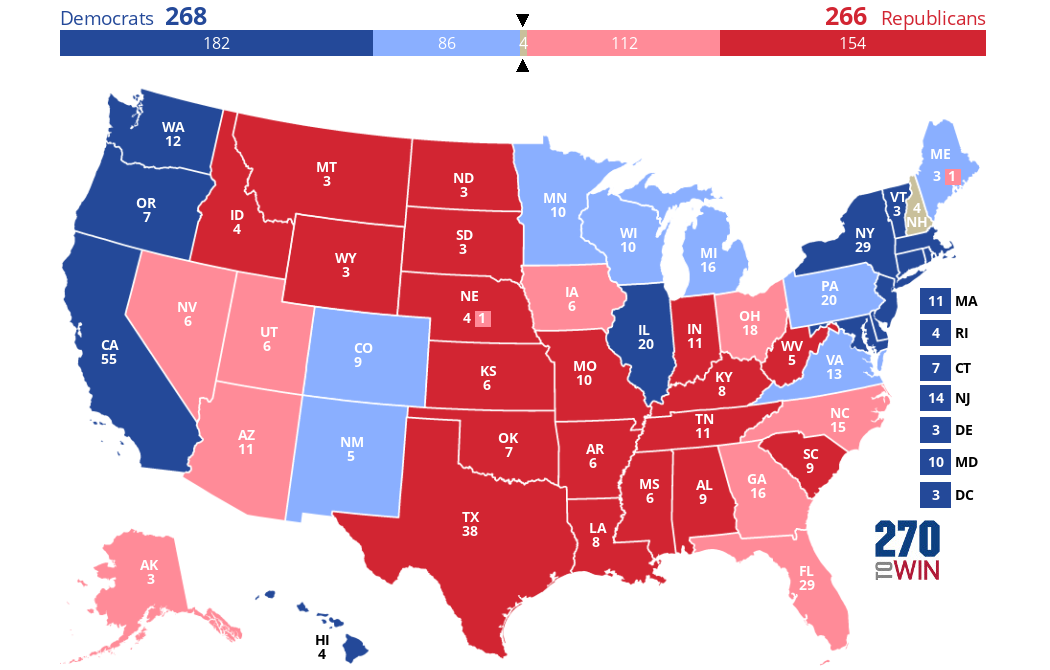
Here is your presidential election night scorecard! With this you can keep score of how the election is going (better than the networks are allowed to tell you) throughout election night.

You will start with this map on the 270 To Win website:


Click here to load this map into a new tab. You can then start to manipulate this map, but don't do it right now.

This scorecard is not my prediction map. It is simply a map of what the states should look like in an extremely close election.

Remember that our presidential election is not decided by popular vote. Instead, each state is awarded electoral votes equal to the number of representatives in the house plus the number of senators (always two). The winner in each state is awarded all of its electoral votes. There are 538 electoral votes in all. The candidate which gets a majority (270) of electoral votes is the winner of the election.

Here's what the various colors mean:
  • Dark blue -  Clinton must win this state. If she doesn't, she is almost certain to lose.
  • Dark red - same for Trump. If he doesn't win, he is almost certain to lose.
  • Light blue - Clinton should win this state if she will win the election. If she loses the state, she must make it up by winning those electoral votes out of the light red (or beige) states
  • Light red - same for Trump. Losing means he needs to win the electoral votes among the light blue (or beige) states
  • Beige - New Hampshire. Not assigned to either candidate. In a close race, New Hampshire is the closest to a tossup.

Here's how to keep score:
  • When the networks call a state for a candidate, change it to dark blue (by clicking on it one or more times until it becomes dark blue) if Clinton won, or dark red if Trump won.
  • If McMullin is called for Utah, make it beige. McMullin is a third-party candidate that is really only competing in Utah to spoil the election for Trump.
  • When one candidate has 270 or more, that candidate is leading.
  • When one candidate has dark color of 270 or more, that candidate has won the election.
  • If a dark blue state is called for Trump, then he is all but certain to have won the election.
  • Same for Clinton. Converting a solid color from one to the other pretty much means game over.

This scorecard will allow you to be steps ahead of what the networks reveal. They *may* tell you who is winning, but you'll know why and which states the challenger is likely to make it up with.

Which brings us to which states each candidate is more likely to flip:
Clinton is most likely to flip, in order, NV,  NC, FL, ME CD 2, NE CD 2, OH, IA, AZ, AK, GA
UT is a wildcard. It could go to either Clinton or McMullin, but Clinton will have a difficult time flipping it.
Trump is most likely to flip, in order, CO, PA, ME, MI, WI, MN, NM, VA

For example, if Trump flips Virginia, it is probably a very good night for him. If he flips Colorado, he becomes a slight favorite.

One final note: Nebraska and Maine award their electoral votes based on congressional district. On the lower right corner of the map is a way to set the electoral votes based on that. And while Nebraska statewide is solid Trump, the second congressional district is only a "should win" for him. Maine, on the other hand, statewide is "should win" for Clinton. However, the second congressional district is "should win" for Trump.

Here are the poll-closing times of each state. These are expressed in Eastern Standard Time.

7 PM: GA, IN, KY, SC, VA, VT
7:30 PM: NC, OH, WV
8 PM: AL, CT, DC, FL, KS, MA, MD, ME, MO, MS, NH, NJ, OK, PA, RI, TN
8:30 PM: AR
9 PM: AZ, CO, LA, MI, MN, NE, NM, NY, SD, TX, WI, WY
10 PM: IA, MT, NV, UT
11 PM: CA, ID, ND, OR, WA
12 AM: AK, HI

Happy election night! I hope my candidate wins!

Friday, May 27, 2016

Tips for Cross-Country Driving

Going on a really long road trip? Like, say, 2,000 miles or more? Have you ever dreamed of driving across large portions of the U.S., even coast-to-coast? Do you have to do such a trip for a move? (Hint: you don't).

Maybe you said yes to any one of these questions, but you're not sure how to approach such a trip? What about safety? What about speed? How much time can I drive before I need to rest? Etc. etc. etc.

This post gives you tips on how to approach your trip. I'm a veteran of the cross-country trip:

Seattle to Boston: 2000
Boston to Nevada to Boston: 2002, 2003, 2004, 2008, 2011, 2014
Boston to Orlando to Boston: 2003
Boston to California to Boston: 2016 (upcoming)

I'm focusing on the U.S. because that's where I've done all of my trips. Driving across Canada, I think, can be more remote, in general.

I've tried to organize this in order of decision-making process. Here it goes:

Tip: Don't Panic
Driving across the country is not as hard as most people think it is. The knowledge in this post should help give you reassurance. Cross-country driving is a lot of fun.

Tip: Fuel will cost you plenty. Consider a better gas mileage vehicle. Go when gas prices are low, like they are today.
A trip across the country and back is approximately 6,500 miles. At 25 mpg, with gas currently at $2.313, fuel will cost you $601. That's a lot, but I once took my Ford Expedition at 15 mpg, with gas at approximately $4, approximately 6,500 miles, for an approximate cost of $1,733.

Tip: Your biggest expense could be lodging as long as gas prices stay low. You can save $ by staying in cheaper hotels, camping, or even sleeping at truck stops. Driving through the night will save you a bundle.
I like to stay in Holiday Inn Express, which runs you on average $135/night. But there are cheaper options, not just cheaper hotels.

Tip: Bring the Following:
  1. A first aid kit 
  2. A flashlight. Probably two
  3. One full-sized blanket or sleeping bag for every person in the car
  4. Bottled water. Especially if you'll be driving in the desert. A case of 24 should do.
  5. Some form of audio entertainment.
  6. A full-size USA road atlas. I prefer the Rand McNalley trucker's (laminated) road atlas
  7. A GPS-enabled device
  8. A Web-enabled device (with Web sites forcing the use of crappy apps on mobile devices, I recommend a laptop)

Tip: Make Sure Your Tires Are Properly Inflated
Both beginning and during the trip. So bring a tire pressure gauge.

Tip: Don't Let the Fuel Tank Go Below Half Full
Any time you are in an unfamiliar area, where you don't know where you're going to get your next fuel stop, you should err on the side of caution and fill before it gets down to half a tank. This is especially true when in remote areas of the country where gas stations are few and far between. I'm sure the gas stations in the little town in the middle of nowhere would appreciate the business no matter how small. And even when on the Interstates, all sorts of things could happen to prevent you from getting to a gas station (and even Interstates go through remote areas). Picture you're stranded at the side of the road, it's night, it's cold, and you need the car's heater. Well, that car will use gas while idling.

I also find that if I take a bio break every two hours or less, roughly the car will need to be filled up (at half a tank) every other stop. I've timed this. Filling up the tank really doesn't cost you any time when it's also a bio break (for me it adds one minute).

Tip: You May Want To Travel Light And Stay In Hotels With Laundry Facilities. And Then Bring Lots of Quarters.

Tip: Go To Places When The Climate There is Mild

You need to first determine where it is you want to go. This may be an iterative process, since it can depend on when to go. Assuming you can choose, this depends on a lot of factors.
  1. Every passenger's availability
  2. Climate along the route (including severe weather potential)
  3. Amount of sunlight available
(2) can be found on various sites. www.accuweather.com has average temperature data for a given day of the year. Remember that when you get up in the morning, the temperature should approximate the "Lo" temp, while around 1pm in the winter (4pm in the summer) the temperature should approximate the "Hi" temp. NOTE: tornado season in Texas and Oklahoma is April-May. Going north from there in the midwest, the season gets later, until it's July in Minnesota and North Dakota. NOTE: it can snow in the Rockies any time from mid-August though the end of May. But you are probably safe May through September.

(3) is important because you may only want to drive during the day. You'll have a lot more time for both driving and sight-seeing if you go in June rather than December. www.sunrisesunset.com has sunrise and sunset data for any date and location in the U.S.

Tip: Drive at Night In Non-Scenic Periods
I find the U.S. west of the Mississippi river to be very scenic. East, not so much, but there are some exceptions. I always drive straight through the Eastern U.S., even in the dark. In the Western U.S., I only drive at daylight if I can, so I can take in the scenery. This means that, when I drive from Boston to California, I drive all the way to the Mississippi river (or thereabouts) without staying at a hotel, throughout the night. And I'll go further than that as long as it's daylight.

Tip: Blast Through The Areas of Non-Interest
This is pretty much a corollary of the previous tip. For blasting through, I typically look at a 28-hour driving session. Most hotels have check-out time at 11am, and check-in at 3pm. So I drive from 11am on day 1, through the night, to 3pm on day 2. With no time change, that's 28 hours. Remember because of the time zones, if you're heading west, it will probably be 29-30 hours, and heading east, 26-27 hours. This way I can travel 1400-1700 miles in one driving session (two days, 700-850 miles per day), but I still get a long break (check-in to check-out time) to recover.

Tip: Yes, I And My Wife Have Driven From Boston To Nevada Without Stopping Anywhere To Sleep, Pulling A Travel Trailer, No Less
But I don't recommend it. We only did it because forces beyond our control connived for us to leave really late but we had to get to our destination at the time we originally planned on. On the return trip, we had to sleep for three hours at a truck stop before I was rested enough to drive. If you're driving across the U.S. just to say you did and want to keep lodging costs to a minimum, this is an option.

Tip: Use At Least Two Drivers
I find I can't drive for more than 6-8 hours before I'm too fatigued to drive (though it's variable based on road conditions). And the longer I drive, the more rest I need later. If you do have only one driver, I would expect only 6 hours of driving per day. But the important thing to know is what your own limits are. Driving is dangerous if you're too fatigued.

I recently tried a 12 hour trip as the sole driver. The results were a disaster. I had to continually ingest so much caffeine that it made me sick for the next day and a half. Or maybe it was the fatigue from driving that made me sick. Either way, stick to a 6 hour day. Not that I couldn't do the 12 hour trip in a day--I did, but the price was heavy.

Having said that, you can drive much more in a day with two drivers. I find 4-6 hour shifts are ideal. I leave the back seat free (which means in a standard car you can only have three on the trip) so the driver next up can sleep lying down, though it might be fine to sleep sitting up, depending on the person. 4-6 hours driving. 4-6 hours sleep. 4-6 hours driving, etc. So you can break up your 26-30 hour blast-through in 6 4-6 hour shifts.

Tip: If Driving Overnight, Three Drivers, One Actively Driving, One Navigating (And Using the GPS), And One Sleeping, Is Ideal
Rotate your shifts: driver, navigator, sleeper. And you don't want more than three people in the car so that the sleeping one can stretch out on the back seat. This applies to all standard cars and SUVs. Extra-long SUV's and large Vans may allow for more passengers. The point is to have room for one person to stretch out and get a decent sleep. I've tried sleeping in an upright seat, and the rest is not near as good, at least for me, as it is stretched out in the back seat. With two drivers, then just alternate driver and sleeper. I and my wife do this all the time. Sometimes we can get through the night, sometimes we have to stop for both of us to nap, but usually not for long.

Tip: Full-Day Driving Should be Kept To 10 Hours Or So
Wake up at 6am. Hit the road by 8am. Reach your destination by 6pm. In bed by 10pm. Repeat.
Note that if you're driving in or around December, you may be driving some of this at night. In June, it is tempting to drive through all 14 hours of daylight, but I don't recommend it, unless you have three drivers. By keeping it to 10 hours, you have two driving shifts of 4-6 hours each.

Tip: Never drive when fatigued.
You find yourself ever-so-slightly closing your eyes, nodding off, shaking your head back awake. Just don't drive in this condition. Once you see the first symptoms of fatigue to set in, find the nearest truck stop/travel plaza and bring on the next driver. If no drivers can drive, just you all sleep in that truck stop (see below) until one of you wakes up and feels they can drive. Screw the schedule. By driving impaired you are putting at risk your lives and those others on the road with you. A day at the Grand Canyon isn't worth that.

Tip: Truck Stops And Toll Road Travel Plazas Are Your Friend, Rest Areas Not So Much
Truck stops are open 24 hours (including restaurants, but not always). The bathrooms are kept clean. The parking lot is well-lit. They've got most things you could want for a road trip. They have free wi-fi. They have showers if you want that. They are everywhere. They are a great place to sleep in your car when there is no driver capable of driving, or simply if you want to save the $ of a hotel stay (they're designed for that purpose). On toll roads, travel plazas take the place of truck stops, but they are similar.

Truck stops almost always have one or more restaurants, usually fast food but TA's always seem to have a sit-down restaurant (but usually no fast food). The truck stop's web site can tell you if the restaurant is open 24 hours. Your GPS may have a phone number with which you can call ahead.

You can't miss a truck stop (usually). They are flowers trying to capture the bees on the road. They have big signs, usually with gas prices on them. There are generally truck stops or travel plazas every 30 miles or so. But for some places (like eastern Wyoming on I-80) the gap is longer. If you never let your tank fall below half full, then you should be fine just getting to the next truck stop.

The various brands of truck stop:
Rest Areas can be a little shady and sometimes dangerous at night. Maintenance of the restrooms is dicey. But if you're fatigued, use your best judgement. If there's a truck stop 5 miles down the road, maybe it's worth driving the five miles to have the have the added security of a truck stop. 30 miles . . . maybe not so much. Use your best judgement but just keep in mind: truck stop -friend, rest area - no so much.

Tip: Use a Good GPS Hopefully With The Feature To Search For POI (Point Of Interest) Along Your Route
Twenty years ago, few people had ever heard of GPS, but now they're everywhere. Between me and my wife, we own at least seven GPS-enabled devices (there may be more around here somewhere . . . ). Though I have driven across the country three times without a GPS, I wouldn't recommended it. Having one that searches for POI along your programmed route is ideal. If not that, then one that searches for a POI closest to your current location (which could yield results outside your route path which is why you want one that searches along the route, but maybe that's just not available to you).

Tip: Use a Good GPS Hopefully With The Feature To Search For Truck Stops
If your GPS won't search specifically for truck stop POIs, then maybe it can search for named POI. In that case, put the name of the truck stop you like (i.e., "Pilot") and see what comes up. Unfortunately, if you don't find one, you'll have to use a different named truck stop to search again, and iterate until you find one that will work.

Tip: When Someone Needs A Restroom, Use Your GPS To Find The Nearest Truck Stop/Travel Plaza And Stop There
Truck stops are so much nicer than regular gas stations.


Tip: Walmart is Everywhere And Your Friend
They have practically everything you need and they're everywhere and, except for New England, almost all of them are open 24 hours. They have well-maintained restrooms. At most Walmarts (but not all), you are allowed to sleep in the parking lot.

http://www.walmart.com

Tip: Starbucks is Everywhere And Your Friend
Good for that caffeine fix, or just a snack and a drink, but also they have clean restrooms, free wi-fi, and no one asks if you've bought anything before or after using them.

http://www.starbucks.com
 
Tip: Use The GPS To Find Your Next Hotel As Soon As Possible If Not Selected Already
Usually the POI information from a GPS will include the phone number to see if there's room available. You want to do this early, as hotels can get booked up.

Tip: Web Search Also Works For POI If GPS Can't Do The Job
All truck stops and Starbucks have free wi-fi. If your GPS is lacking, you can do a web search to find your next stop (or one down the road).

Tip: Try To Do All Of Your GPS Searches While Stopped
This means figuring out your next stop at your current stop. It means searching for hotels proactively. It's really difficult to find stuff while driving. You'll do it when you have to, but you'll quickly realize that you don't want to.


Tip: RVs Use A Ton Of Gas
My Ford Expedition towing my Travel Trailer got 4-7 mpg. I had to fill up every two hours. It cost a bundle. Your standard non-trailer RV gets about 10 mpg. However, they're a great way to travel and allow for drivers to get plenty of good sleep.

Tip: Have A Bio Break Every Two Hours Or Less
There's not much worse than really needing a bio break, but you're still 30 miles from a truck stop. I find that if you stop every two hours or less, and you instruct your crew that they MUST use the restroom every time, discomfort is minimized.

Tip: Use The Restroom To Urinate Whenever Available
If you don't do this, you risk needing to go way before the next stop.


Tip: Know Your Next Sleeping Destination
You should be able to calculate how much distance you can cover in a day, and then use map tools like your GPS or HERE Maps or Google Maps to determine where you will want to stay the next night. Remember to subtract for sight-seeing time. Then you should be able to pick your hotel using a site like www.hotels.com, but there are countless others. One time we had to settle for the Lazy Inn in Fernley, NV, because we had no reservations, and I would not want to repeat that experience.

Camping can be a fun and cheap way to go, but it's harder to do research on campgrounds, and usually you still need reservations (http://www.reserveamerica.com). If you don't have an RV, you need to set aside extra time to set up and take down the camp.

Tip: Expect Approximately 52mph On Interstates and Rural Highways Including Bio, Fuel, and Meal Stops
Thus in a 10-hour driving-day you can cover 520 miles. In a 28-hour blast through you can cover 1456 miles (conveniently, a little less than half the width of the U.S.). Not including stops, here's the average speed I get on the Interstates and Rural Highways:

Speed Limit           Target Top Speed     Average Speed
65                           70                             64
70                           75                             69
75                           80                             71
80                           85                             71

Note that I try to maintain 5 mph over the speed limit, but, as you can see, traffic has some say in the matter. I would caution that if you try to maintain 10 mph over the speed limit, that those numbers won't go up by 5, not even near that much. As you can see from my table, increasing my target speed from 80 to 85 does not actually increase the average speed. Contrary to popular opinion, raising speed limits at the high end does not induce the highest-speed traffic to flow faster. It does induce the lower-speed traffic to flow faster, thus minimizing speed differential and thus reducing collisions (which is why you shouldn't target much more than 5 mph over the limit). It also lowers the number of speeding tickets.

Tip: Go Around Large Cities
If you're not stopping in a large city, consider going around it. It may be more miles to travel, but traffic in large cities is unpredictable, and the speed limits are usually lower. The worst cities I find are Boston, New York, Philadelphia, Baltimore, Washington, D.C., Cleveland, Chicago, Atlanta, Los Angeles, the Bay Area, and Seattle. I'm sure there are others, but smaller cities are generally fine. Don't bother going around Omaha on I-680, for example.

Tip: You Don't Have To Do This
No matter what your situation, you don't have to drive cross-country. You can have your things shipped, you can have your car shipped, and you can pay for plane tickets. Once you've planned the trip you may find that flying and shipping is cheaper. If you want to see the countryside, consider taking the train. There are pros and cons to everything, just be aware that you have choices. But it is great fun and worth doing as long as you can afford the time and $. If you're not sure it's your cup of tea, you still may want to try it once, if nothing more than to say you did it.


Well, that's it for my tips. Actually planning your trip ahead of time is good if you have the time (time you'd otherwise spend while on the road). But that's a whole other blog topic. If I write that one, I'll provide a link to it here.

Happy Road Trip!